
Legends for lunch
On 11 February 2026 there was a celebratory lunch with the past recipients of Resolution’s John Cornwell Lifetime Achievement Award attended by most of the recipients along with Melanie Bataillard-Samuel (chair), Lucy Loizou (vice chair) and Colin Jones (chief executive). This was fantastically organised by David Emmerson.
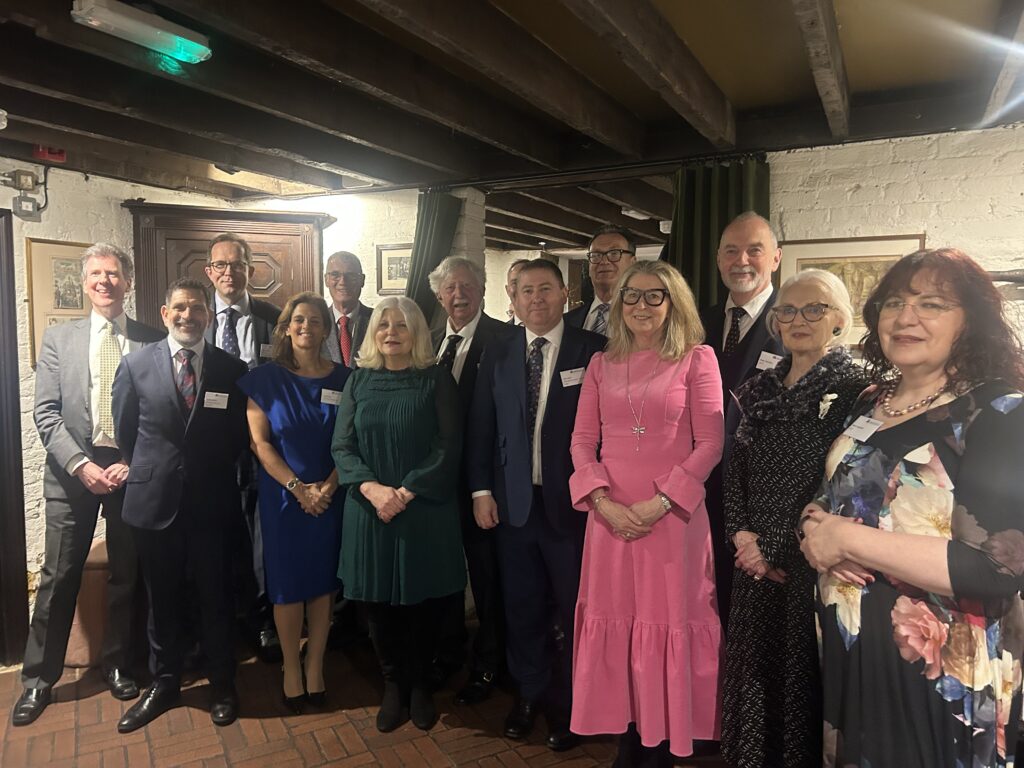
Pictured, left to right: Justin Lees, Grant Cameron, Edward Cooke, current Resolution vice-chair Lucy Loizou, Nigel Shepherd, Karen Barham, Richard Sax, CEO Colin Jones, Rhys Taylor, David Emmerson, Elaine Richardson, Roger Bamber, Angela Lake-Carroll and Denise Ingamells
Each of those who had received the award had done so for different, but impressive reasons, though a common theme was their lifelong work to encourage and develop the use of out-of-court models of dispute resolution and very much practicing what they preached in terms of avoiding a confrontational approach.
We were struck by the modesty and generosity in the room, legends who still speak about their contributions with humility, and who continue to mentor, innovate and quietly change mindsets.
The recipients were:
2025: Justin Lees
2024: Maggie Rae (posthumous award)
2023: David Emmerson
2022: Denise Ingamells
2021: Peter Jones
2020: The Pensions Advisory Group (PAG), represented by Rhys Taylor
2019: Elaine Richardson
2018: Edward Cooke
2017: Barry Bunyan
2016: Karen Barham and Angela Lake-Carroll
2015: Roger Bamber and Felicity Sheddon
2014: James Pirrie
2013: John Cornwell (posthumous award)
During the lunch, we lucky enough conduct an interview with Richard Sax, an attendee at the inaugural SFLA/Resolution meeting, and its second Chair. David Emmerson asked the questions
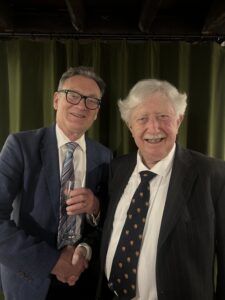
David Emmerson (left) and Richard Sax
It was a pleasure to catch up with Richard Sax and he kindly agreed to answer some questions about family law in the past and how the then SFLA was founded and developed.
Richard was one of the pre-eminent family lawyers of the time. He undertook Articles at Rubenstein Nash, a firm whose family department he helped develop and then merge with Manches, and he remained a partner there until his retirement.
Richard was at the first SFLA meeting and many others thereafter, becoming its second chair for a two-year term of office. He, along with John Cornwell, were the first solicitors to become Deputy District Judges and he sat for many years in the Principal Registry.
Richard became President of the European Chapter of the International Academy of Family Lawyers and was the editor of Butterworth’s Family Law Service. For the Rowntree Foundation he wrote an influential report on the necessity of cohabitation law reform back in the 1980s. He was on the advisory board of the Institute of Family Therapy and on the board of Cafcass
Richard, can I ask you, before the SFLA was formed, I think in 1982, what was it like practicing family law. How did you become involved in family law and where there any lawyer groups specialising in family law and offering training and support.
I became a family lawyer by mistake because the family law partner had to go off sick for three months and I stopped doing libel, slander and copyright and went to do family law. A good background obviously. At that time, you had to prove a matrimonial offence, you had to go to court to get a divorce. To talk about money was a bar to divorce, to seek to reconcile stopped everything in the tracks, and you had to commit another matrimonial offence in order to get going again.
What was a matrimonial offence?
Adultery, cruelty or desertion, I think that was it. If you were an adulterous wife you lost your house, you lost your children and you were disgraced. It was a social disgrace to be divorced. It was a very, very different scene in the 1960s.
My partner, Joan Rubinstein, joined the Archbishop of Canterbury’s Commission on Divorce headed by the Bishop of Exeter, recommended that the sole grounds for divorce should be the irretrievable breakdown of marriage evidenced by one of five facts: adultery and its intolerable, unreasonable behaviour, 2 years’ desertion, 2 years’ separation, and by consent, 5 years’ separation.
So amazingly it was recommendations from the Church, with the help of a Welsh MP, Leo Abse, that led to the Divorce Reform Act in 1969. But they didn’t then produce a new money law, so collusion and so on still remained and therefore the one thing everybody wanted to talk about was money and you weren’t allowed to. So they tweaked the rules, and you could go for a special hearing under section 5 before a judge to have your agreement sanitised by court order.
We then moved on, and with quite a lot of pressure from the Bar, because the Bar suddenly thought they were going to be out of work because they didn’t need to appear in court anymore. So they thought, ‘we’d better do some money’, and so the laws changed and we were allowed to talk about money and the principles of financial provision on divorce were established.
What was the impact of the change in the law?
With the arrival of Matrimonial Proceedings and Property Act 1970 and of the Matrimonial Causes Act 1973 we now had a financial framework ideal for what became in 10 years’ time the SFLA approach and principles to be followed. But then we had no specific case law or guidance to show how it should be applied with consistency. The Bar, the judiciary as well as family law solicitors were keen that this should be developed as fast as possible.
The great Lord Denning, by then back in the Court of Appeal came to the rescue in the case of Wachtel where the issue and relevance of conduct was to be considered as the wife had committed adultery with her doctor. Lord Denning found that conduct was not relevant unless it was so severe as it would be inequitable to ignore it or gross and obvious. Also, in the same case Lord Denning proposed 1/3 / 2/3 division of assets as a guideline with the FMH invariably joint and equal.
As an aside, the legislation also abolished the remedy of “Restitution of Conjugal Rights” which had somehow survived into the modern era.
Were there any specialists in family law?
There was the Family Law Bar Association and there was also something called the Family Law Committee but that was only responding to consultation papers and its interest was in family lawyers, not family law clients.
In most firms, family law was part of the litigation department. The big firms were dominated by these grumpy old men – and a couple of grumpy old women – and there were young people like me who were terrified of them. And family law was something really not to go into, rather the reverse.
But actually, most of us were trying to make things better. John Cornwell was at a small firm in Red Lion Square, and sometimes he could be quite a grumpy man too, and he had a grumpy moment when somebody who’d been really nasty to him and he thought, I’m not putting up with this anymore! No more grumpy letters! And so he wrote to everybody for whom he had files open, which I suppose was about 30 people, about a non-confrontational child and family-centred approach.
I was one of the recipients and he had invited us to a meeting at the South Place Ethical Society in Red Lion Square (now Conway Hall). About 20 of us turned up and we talked about what he’d set out in the letter. There was amazing unanimity that this is something we wanted to pursue – a new way of doing divorce and with a code of conduct which would enforce it. The next thing we knew there was an advertisement in the Gazette, and we had a meeting at the Law Society at which about a hundred people turned up.
There were very few from outside London. I’m not sure if there was anybody from outside London. Maybe only David Salter.
At that meeting we adopted a constitution and there were volunteers for Secretary and Treasurer.
First thing we did was to have a committee to draft the Code of Practice.
How many people were on that?
Six. I think we met at Charles Russell [now Charles Russell Speechlys] and it took us about three months, I think.
Can you remember the sort of key things you were focusing on?
Being client and child-focused.
We were very nervous about enforcing the Code and whether the right way of enforcing it was to throw people out or to educate them. Anyhow, that was the first thing we did. Next thing we did was to make contacts all over the place. So, we had bimonthly meetings with the FLBA and we met with the President every three months.
We just went around the place. I remember going to Plymouth, to Norwich, to Newcastle, to Bristol. All over the place.
How did you publicise that? How did you say where you were going to?
We rang up and found out who the prominent local family lawyers were. There usually was a local Law Society and a family law group. So we did a lot of that. We did a lot of education. I remember being absolutely sick and fed up of pensions in divorce! [much laughter as RS sitting opposite Rhys Taylor of the Pensions Advisory Group (PAG)]
David Salter and I went to The House of Commons and the House of Lords. So we just got ourselves round a bit. My wife complains about how, 40 years later, I was never home at weekends. Because I was always going off and doing SFLA things.
What was your reception like?
Very enthusiastic. It was like a leak somewhere and then the ceiling bursts and water goes everywhere. It was remarkable. It was something we all wanted to do.
Going back to the first year – you set up committees? Trips round the country were set up? The code was drafted? That is quite a lot.
It was a busy first year. And the chatting with the President and the Family Law Committee and the FLBA and the mediators.
When was the first annual conference?
That was four years in. 1989 in Birmingham. The guest speaker was Brenda Hale, who at that time was at the Law Commission. My office was opposite the Law Commission, and we used to meet at lunchtime in a Sicilian restaurant on Theobalds Road.
Were you Chair at the time?
By then, yes. Then I think we had a conference every year.
Can you remember any of the people who were at the first meeting?
Jane Simpson, Diana Parker, Mark Harper, Helen Ward, Michael Drake and Blanche Lucas are people I remember. Peggy Ray, was I think a very early member. Because the ALC regarded themselves as quite different – because they did public law and practised in the magistrates’ court – they were initially reluctant to join forces.
Lots of people claim to have been there!
Well, some saw it as an opportunity for client promotion. That’s why they joined – thinking they’d get something out of it.
How do you think you got on with the judiciary trying to sell this idea?
The President was keen. There was general enthusiasm. Initially more from the judiciary than the Bar, because I think the Bar thought they might lose out on the court work and feared that the SFLA approach would lead to a reduction in work. They soon had keen supporters, led by Alan Ward, when we got rid of the bar on talking about money.
Richard, would you like to be practising today?
Well, yes is the answer. I mean, the difficulty before was helping the clients and their children in the way in which they deserved, because the system was against you. And now it is much better, apart from cohabitation. It’s a scandal, isn’t it, when you think how many people cohabit these days, because it’s no longer a social disgrace to cohabit, and yet they are lacking in remedies. Maybe through a false view that that will weaken marriage? Maybe? I don’t know.
What would you change?
Well, cohabitation law for a start.
We have in the room the current chair and vice-chair of Resolution. What advice can you give to them?
I think Churchill had a favourite phrase, which was, keep fighting on.
Richard, it has been such a privilege just to listen to you.
The privilege is mine.
I can tell you it is absolutely ours, and it’s been so magical to listen to you. It really has. Thank you.
David Emmerson
photo gallery
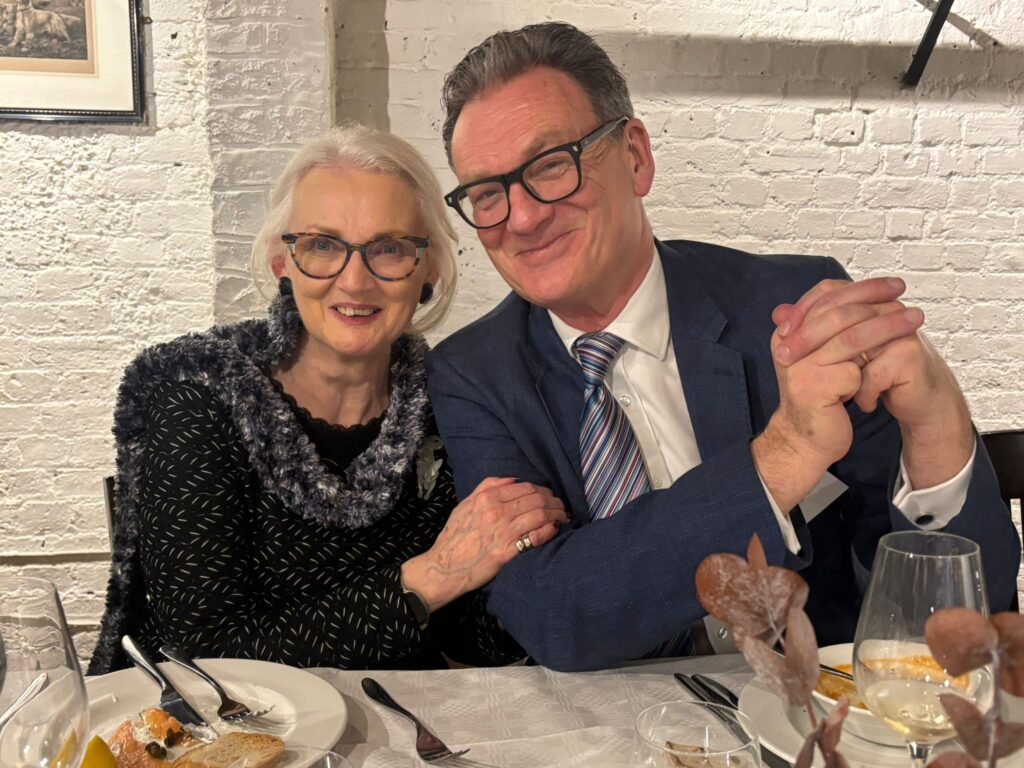
Angela Lake Carroll and David Emmerson
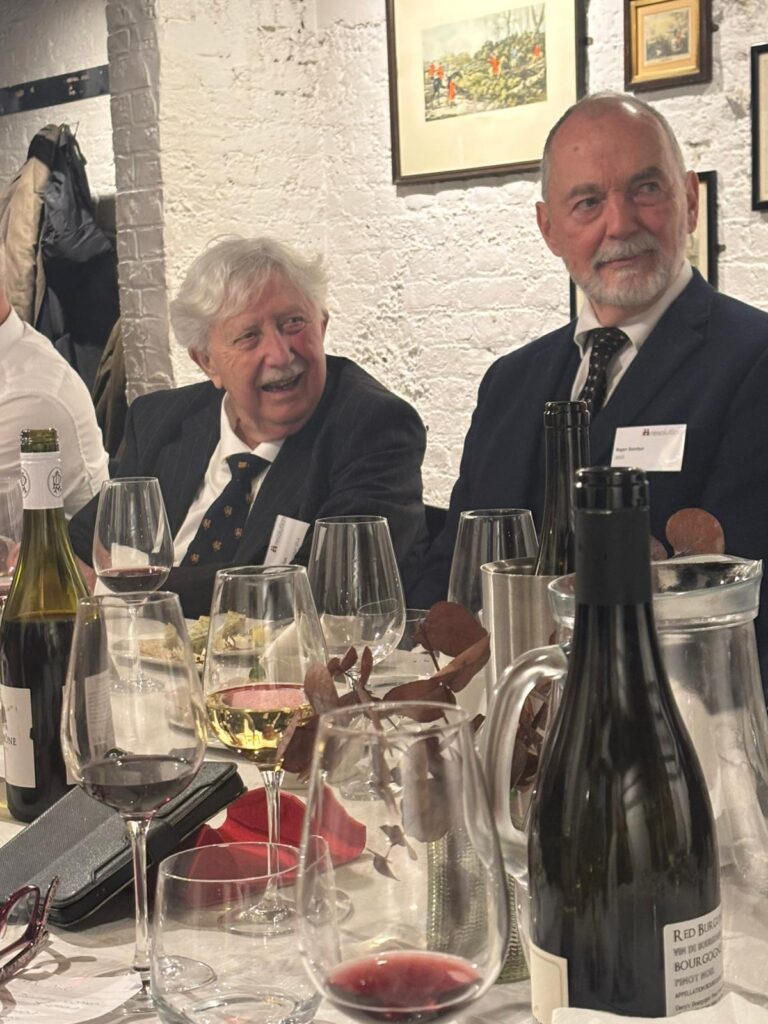
Richard Sax (left) and Roger Bamber
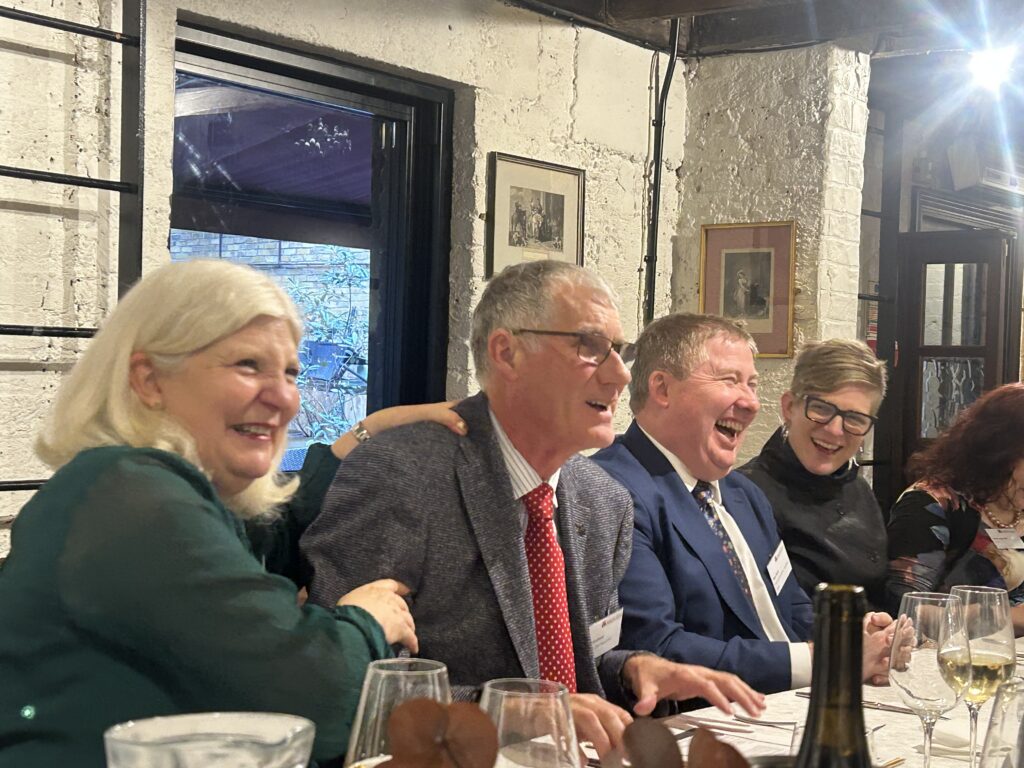
left to right: Karen Barham, Nigel Shepherd, Rhys Taylor and Claire Easterman (Resolution Director of Operations)
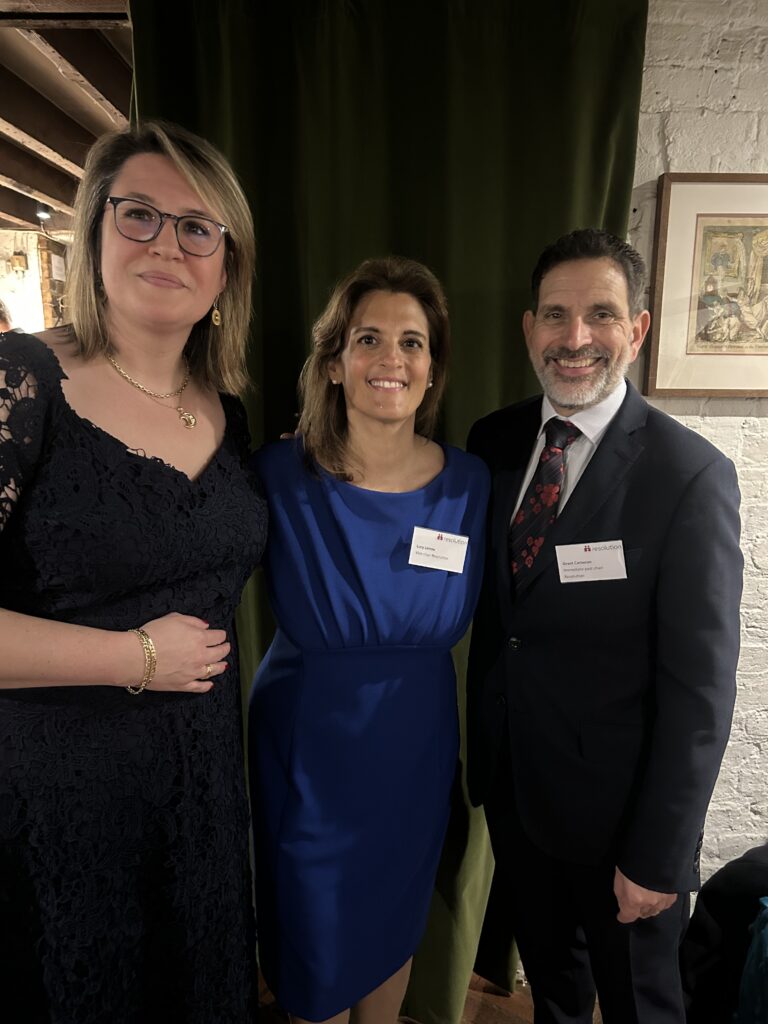
Melanie Bataillard-Samuel (chair), Lucy Loizou (vice-chair) and Grant Cameron (immediate past chair)
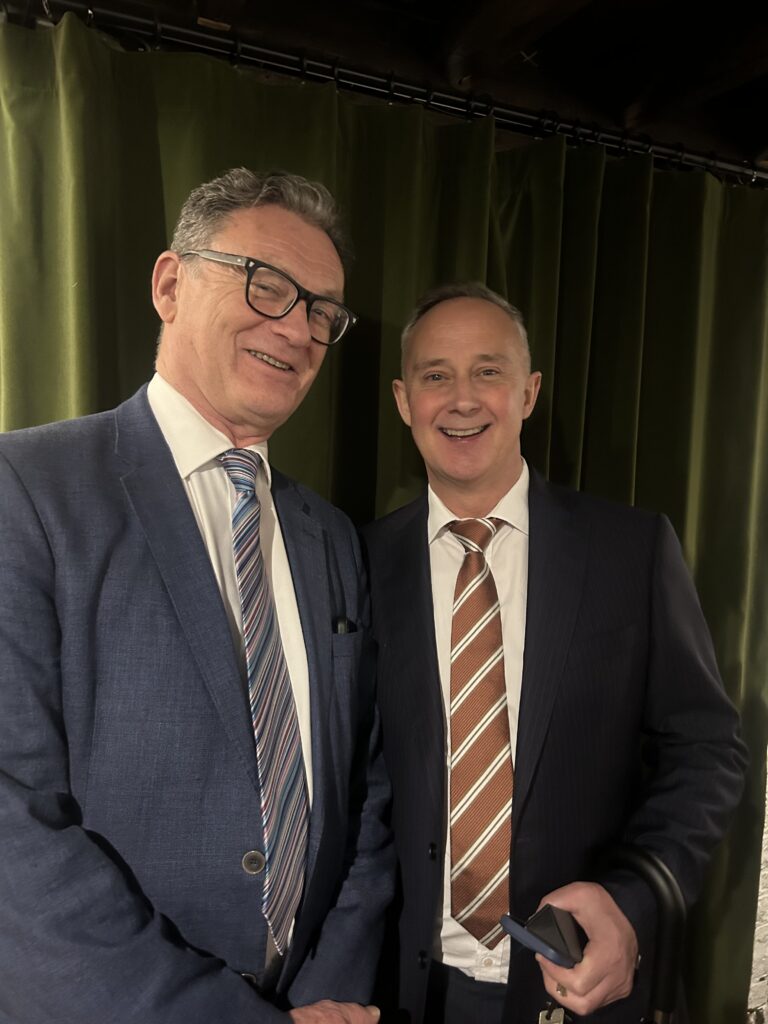
David Emmerson and Colin Jones, Resolution Chief Executive
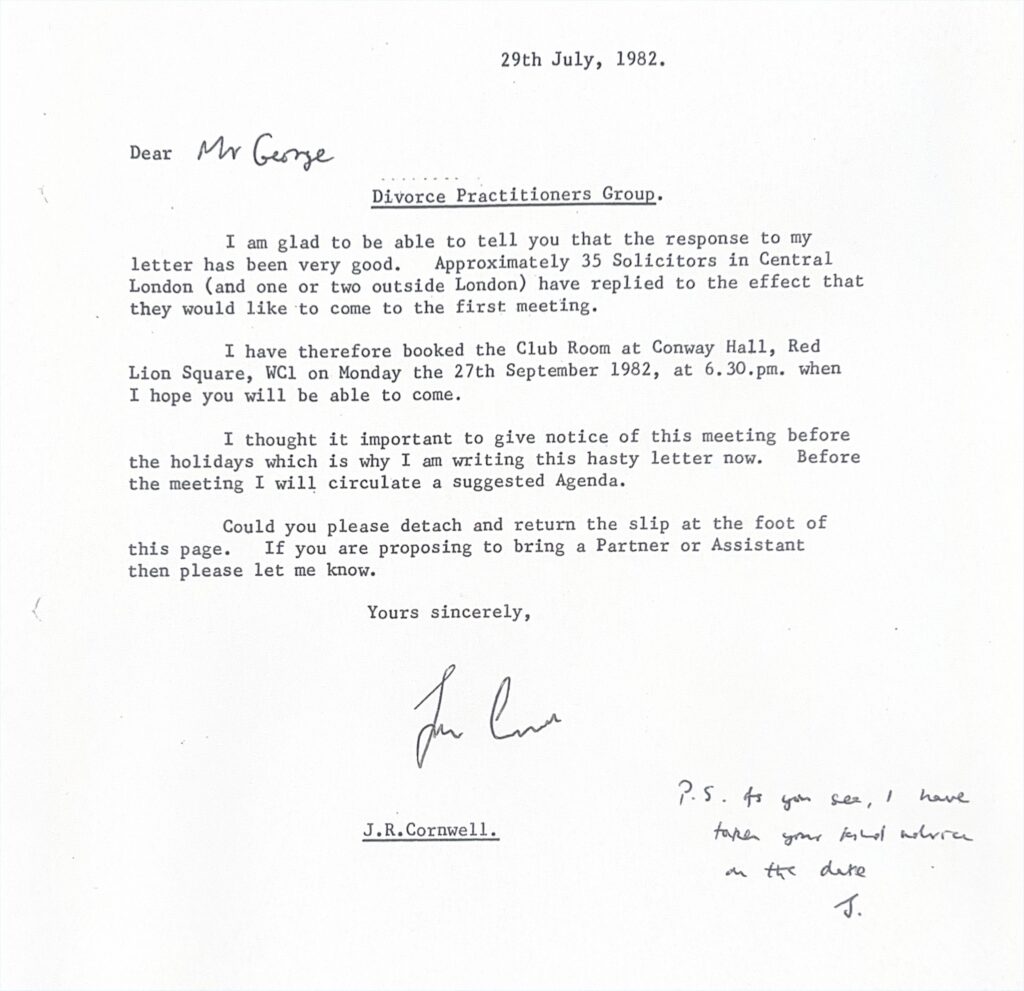
copy of an invitation to the first meeting of the SFLA
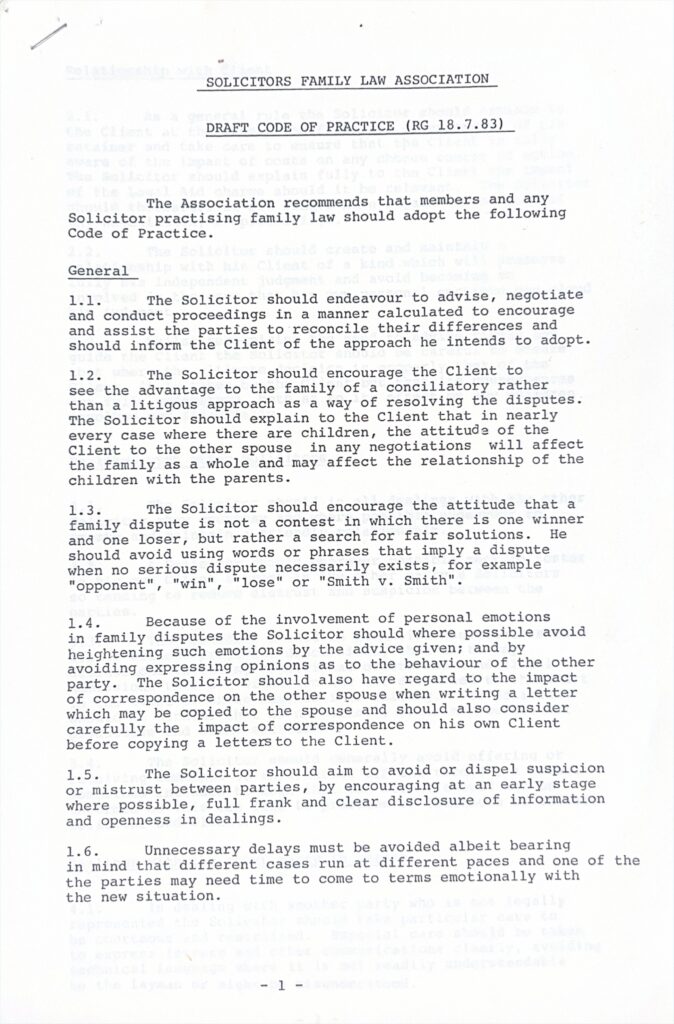
SFLA draft Code of Practice