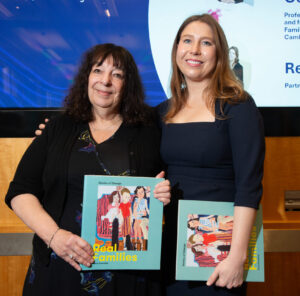
Professor Susan Golombok (left) and Rebecca Christie
What does a “real family” look like today – and who gets to decide? That was the question at the heart of this year’s Henry Brown Lecture at the Dispute Resolution Conference on 26 March 2026.
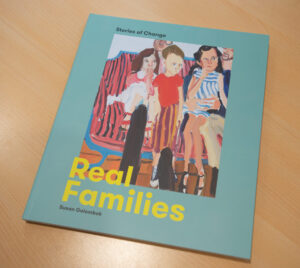
The lecture was delivered by Rebecca Christie, partner in the family and art law departments at Wedlake Bell LLP and co-chair of Resolution’s Domestic Abuse Committee, alongside Professor Susan Golombok, Professor Emerita of Family Research and former director of the Centre for Family Research at the University of Cambridge. Together they explored the art exhibition Real Families: Stories of Change, a collaboration between the Fitzwilliam Museum and the University of Cambridge Centre for Family Research, curated by Professor Golombok, the former Centre director.
Professor Golombok has spent her career studying the changing nature and construction of families, including gay and lesbian families, families with transgender parents, and those created through assisted reproduction, such as IVF, donor insemination, egg donation and surrogacy. Her research has consistently challenged assumptions about these family structures, particularly in relation to the quality of parent/child relationships and the psychological wellbeing of children, and has contributed to changes in legislation and policy both in the UK and internationally.
She explained that this work began in 1976, when she read an article in Spare Rib – the feminist magazine of the 1970s and 1980s, and one featured in the exhibition – which highlighted how lesbian mothers were routinely losing custody of their children on divorce, based on the belief that living with a lesbian parent would cause psychological harm. What now feels unthinkable prompted Professor Golombok to undertake an objective study of children raised by lesbian mothers, laying the foundation for decades of research into the experiences of children growing up in a wide range of family forms.
The exhibition brought together more than 120 artworks spanning paintings, photography, sculpture, film and more. It demonstrated what makes a family today, and the impact our families have on us, through the eyes of contemporary artists.
The exhibition looked at how family life has changed in the past 50 years, bringing into focus aspects of family experience that are rarely centred in traditional narratives and that not put at the centre of museum exhibitions. As part of Professor Golombok’s wider research, the exhibition explored the last half a century of how families have developed and also been accepted by society. For example, an extract from the catalogue features a 12-year-old girl who was born into a queer family and observed that queer families aren’t that different from any other family, it’s the way that they get treated in society.
It also focused on all the different types of families that exist in the world. For example, featuring a piece by JJ Levine called “Alone 19” – which seemingly depicted the nuclear family, a mother, a father, a boy and a girl that society has historically and traditionally told us about. However, if looked at more closely again, the piece depicts the same person acting as the mother and the father and both the baby boy and baby girl, making the viewer question what makes a traditional family.
Rebecca shared with the attendees of the conference what really resonated with her when she first saw the exhibition which was that it showed that families of all different types are everywhere, and every client she has ever worked with was represented, whether as part of an art case or a family case. While some of the pieces focused on the family figures themselves others assessed whether families are the product of the environment in which they live, tackling topics such as difficult economic circumstances or domestic abuse.
 Another aspect of the exhibition was looking at the absence of family. Professor Golombok spoke to the attendees about the pieces in the exhibition by artist, Mary Husted. In 1963, Mary Husted was a 17 year old single mother who gave birth to a baby boy, Luke. Due to being single, Mary was forced to give up Luke for adoption and she had only 10 days with him until he went off with his new family. The exhibition featured three sketches by Mary during those 10 days; at three days old, at eight days old and at 10 days old. Twenty-eight years later, Mary was still dealing with this subject matter, and she made a work entitled Dreams, Oracles and Icons which she donated to the Murray Edwards College Women’s Art Collection. When Luke was 44, he was looking online at the Women’s Art Collection and found this piece of work by his mother and pieced the story together. He tracked her down and they went on to meet each other.
While not an intentional piece in the exhibition, at the end there was a wall for visitors’ comments. There were many, from adults, and children alike, commenting on how it was the first time that they had seen their family represented in oils, pastels, watercolour, sculpture, and that is why Rebecca felt it was so important to bring Professor Golombok’s exhibition to a wider legal audience so that more people should see it and know about it.
For family lawyers, the exhibition is important because the pieces within it highlighted the profound shift in family structures and societal reactions over the past 50 years and the reality of the families that we work with in everyday practice.