

One of the questions I found myself asking most often when I was a trainee solicitor and subsequently an NQ was: “How am I going to be able to advise parents about decisions relating to their children?”
Without any children of my own, I felt that I had little experience with children generally and was conscious that I had not lived any of the experiences that my clients dealing with a separation had. I wanted to be able to help clients without coming across as patronising, or not understanding of their specific situation, since as we all know, there is so much more to family law than the law itself, and much of advising clients in relation to children involves relying on experience and of outcomes in similar cases.
While these conversations don’t feel quite as daunting six years on, if, like me, you are entering the profession at a relatively young age, you will find Parenting Through Separation an indispensable resource.
First and foremost, the aim of the guide is to encourage parents to keep their children at the centre of decision-making. However, it is also invaluable for family law professionals, particularly those at the start of their careers who may feel less confident raising parenting issues with clients or identifying behaviours that can negatively affect children.
Here are a few ways the guide can be a really useful tool for your work with separated parents.
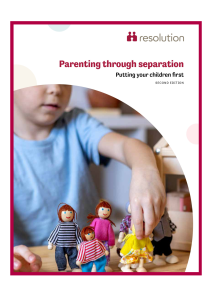
Share the guide with clients
Unless there are strong reasons not to, I will always send the guide to new clients and suggest that, if they feel comfortable doing so, they consider sharing the guide with the other parent. This way both parties have a neutral resource they can refer to; it isn’t related to a specific law firm and hopefully does not feel biased.
The initial meeting will often feel overwhelming and like an information overload for many clients. By giving them the guide they can go away, reflect on it, and come back to you with any questions.
You may even be able to use and refer to the guide to help structure your meetings, pointing clients to specific sections, such as how to speak to children and let them know of the intention to separate in an age-appropriate way.
Real-life perspective
The guide includes and highlights the voices of parents and children who have themselves lived through the process. This can help you to understand how your clients may be feeling and, importantly, how the children at the centre of the process are feeling.
The Family Justice Young People’s Board’s “top tips” for separated parents are particularly powerful in helping clients consider matters from their child’s perspective.
Additionally, the guide includes some really helpful narrative around the stages of grief which clients may experience following the breakdown of a relationship, and which may occur at different stages in that process for different people.
All of this can help us to understand and communicate effectively with our clients. For example, if we are wondering at the outset of a matter why one parent appears less willing to engage with the process than the other, it might be that the other parent is simply at a different stage and needs more time (within reason of course) to accept what has happened and come to terms with it, before proceeding.
Emotional support and practical advice
There are practical strategies to help parents focus on the needs of their children throughout. One aspect that I have found particularly useful is the information detailing how children of different ages might react to their parents separating, behaviours to look out for and how to help the child.
Helping your client understand their options beyond court
Increasingly, our role is not simply to explain the law. We are helping clients make child-focused decisions, consider non-court dispute resolution options and understand how conflict can affect children. The guide includes a really clear explanation of the NCDR options and a handy flowchart for clients to understand how this might work for them.
Signposting and resources
The legal process and different options for resolving disputes relating to children are all set out in client-friendly language, including a glossary of different options for dispute resolution, how they work and things to bear in mind, as well as a “jargon buster” to help clients cut through unfamiliar and confusing language.
The guide also highlights various resources, charities and support organisations for clients to reach out to, including support for victims of domestic abuse and those dealing with addiction.
If you are not yet as familiar with the guide as you would like to be, I recommend grabbing a hot drink, heading to the Resolution website, and reading through at your own pace – you might just find that you end up with some new strategies to better support your clients.
Looking back, I wish I had discovered the guide earlier in my career. It gave me practical tools, but perhaps more importantly, it helped me understand that supporting families through separation is about far more than understanding the law.
If you’re a trainee, NQ or simply haven’t revisited the guide for a while, it is worth another look.
Parenting Through Separation is available for members to download as a PDF for unlimited use. Print copies are available as single copies and in batches.