
Legal Aid: a 40-year perspective
Arguably the Legal Aid situation has never been more worrying than it is now, but we can look back on the last four decades and see some real successes
In this column, we look back at the last 40 years or so of Resolution’s work to support legal aid practitioners. As readers will know, Resolution was formed as the Solicitors’ Family Law Association in 1982 and has ever since then been committed to campaigning for access to justice through legal aid and to supporting its members undertaking legal aid work.
Resolution’s membership stands at about 6,500 practitioners, of whom about 1,000 undertake some legal aid work. Our members provide legal aid across the whole area of family law, including public law care work, private law finance and children law, domestic abuse, abduction and mediation.
 Whilst thinking about this column, I had a look at The History of Legal Aid 1945–2010 which was prepared by Sir Henry Brooke and attached to the Bach Commission on Access to Justice, set up in 2015. I also looked over again the Legal Aid Matters booklet produced by the Legal Action Group in 2019 to mark 70 years of legal aid. Both are important to read.
Legal aid was set up in 1949 under the Legal Aid and Advice Act and has therefore been providing access to justice for over 75 years. Initially it was administered by the Law Society, but during the Thatcher administration in the 1980s, the Legal Aid Board was set up, which has gone through a number of name changes and is now of course the Legal Aid Agency (LAA). When it started up, legal aid was mainly for family and civil cases. Criminal legal aid was introduced in the 1960s.
It’s interesting when reading back over old material to see that, 40 years ago, the same issues and concerns were present amongst those involved in providing legal aid: low rates of remuneration, dropping eligibility levels, and pressure on the legal aid budget. The same exists today, although we add to that the impact of the Legal Aid, Sentencing and Punishing of Offenders Act 2012 (LASPO), which drastically reduced access to legal aid by limiting scope for private law applicants. And last year, practitioners experienced perhaps the most challenging time of their professional lives in the cyberattack on the LAA.
Resolution has had a Legal Aid Committee for very many years. The Committee in its various memberships has contributed more hours than can be counted on lobbying, negotiating, training, speaking to the officials at the LAA/MoJ, responding to consultations, supporting members during contracting, giving evidence to Parliamentary committees and working to support access to justice and legal aid practitioners. All this work takes up valuable time and is done by practitioners in their “spare” time, and they do it as they believe that they can make a difference. We know that our contributions are valued and the LAA and MoJ are keen to hear what we have to say (even if they don’t always agree with us or do as we ask!).
Looking back at the history of the Committee, Godfrey Freeman was the Chair of the Committee before David Emmerson OBE took over, chairing in 2003. He continued to build on the strength of the Committee, which had representatives from around the country undertaking legal aid work. At the time it was thought that about 2/3 of the members were undertaking legal aid work, and David wanted to ensure that Resolution’s voice was strong in the debate about legal aid, and that Resolution supported its members who were doing such work.
David had previously been the chair of the Legal Aid Practitioners Group (LAPG) and had experience there of building strong relationships with the civil servants at the LAA and MoJ. Regular meetings with the teams there enabled issues to be raised with the LAA and MoJ about how legal aid was and was not working for the public and practitioners, and enabled changes to be made. David can recall the production of the costs assessment guidance following discussions to explain to the civil servants exactly how the work was done and how long it took!
There were some significant times when input from the Committee was vital, for example when it came to the challenges of contracting/franchising, which had been introduced in the 1990s. During this period there was heavy engagement with the LAA and MoJ to ensure that contracting met the needs of the practitioners. The principle of contracting was welcomed as it provided regulation and ensured the quality of the legal aid work being undertaken, and Resolution worked hard to assist with its introduction.
During the early 2000s, there was another period of challenge when there was the judicial review of the contracting regime. The results of the contract tender at the time had been disastrous, leaving many firms without a contract, and Resolution worked with the MoJ on a re-tender. However, the judicial review then happened, and the contracting decisions were scrapped following the successful action.
Later on in the 2000s, the issues of fixed fees for case work and advocacy required lengthy and detailed discussions between Resolution (working with other representative groups) and the LAA/MoJ. In particular, Resolution worked closely with the Bar around the alignment of advocacy rates for solicitors and barristers.
Resolution was also successful in negotiating legal aid for the collaborative process, but unfortunately this was lost and never taken forward following the 2010 election.
And following LASPO, the Committee has been clear in expressing its opposition to the changes that LASPO brought in. We were active in participating in the Review of Civil Legal Aid (RoCLA) in 2023.
This working relationship with the LAA/MoJ continues to this day. The opportunity to meet and advocate was never more important than last year after the cyberattack, when there were countless meetings with the LAA and MoJ, and submissions about the fallout of the attack. This work continues as firms get back on their feet after the attack.
David continued in his role as chair and was joined as co-chair by Elspeth Thomson (Managing Partner at David Gray solicitors in Newcastle) in 2005. David and Elspeth worked alongside each other over the next 11 years, until David stood down in 2016. The time given by them to engaging with the LAA/MoJ and attending meetings and steering the committee cannot be underestimated.
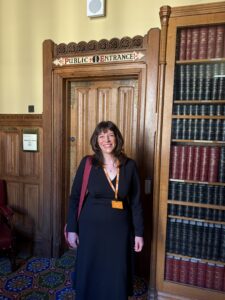
Elspeth Thomson, co-chair of Resolution’s Legal Aid Committee, about to give evidence to House of Lords Select Committee into the Post-legislative Scrutiny of Domestic Abuse Act 2021, 19 March 2026
The Committee is now expertly co-chaired by Elspeth Thomson (now our longest-standing Committee member, having served over 20 years on the committee as chair), and Emma Cordock (Director of the North Region at Cartwright King). Both specialise in children law and work at the forefront of legal aid provision. Elspeth also sits on the National Committee, which is an important connection for our committee with NC. There are currently 14 members of the LA committee and they meet at least four times a year. We simply could not function without Rachel Rogers, Resolution’s Head of Policy, and Vicky Ling, Consultant. Both work extremely hard to support the Committee and attend a large number of meetings on the Committee’s behalf. Rachel and Vicky, and the members of the committee, also work closely with the other representative groups, and we collaborate where we can to support each other and join forces where we have common goals.
We cannot deny that, despite all our work and many, many hours of engagement, there are still very significant challenges, and arguably the situation has never been more worrying than it is now.
First, in relation to eligibility, in 1949 about 80% of the population was eligible for legal aid. By 2007 this had dropped to about 30% and is now believed to be around 20%. We worked with the last government on the means test review, but despite promises of change to increase eligibility, little has happened and this review is now very out of date. It is urgently needed.
Second, in relation to rates, nobody can quite believe that the last rate rise was in 1996, now 30 years ago! In addition, those rates were cut by the Coalition Government in 2011. There are a number of different measures to calculate inflation but, broadly speaking, £1 in 1996 would be worth £2 today. So, our rates at the very least should be doubled! Back in 1996 the rates of legal aid were not that far off the rates that we would charge our clients privately, but the gap between those figures has widened beyond belief.
Third, an area of significant difficulty remains the administration of legal aid, and how difficult it is to provide the work as well as the amount of unpaid work that is required. That said, all legal aid lawyers could put up with the administration and stress of managing a legal aid practice if the rates of pay were improved.
The fourth area of stress for family legal aid lawyers is the desperation felt at the effect of LASPO and the removal of legal aid from the majority of family law cases. This has led to the inability to protect and assist families, and has had a knock-on effect on how litigants manage their relationship breakdown and how the courts cope (or don’t cope) with the numbers of litigants in person. The delays in court are due at least in part to the rise of litigants in person. Whilst those at risk of harm or who have been harmed – and with gateway evidence – may still be eligible for legal aid to protect themselves and their children, we know that many struggle to find lawyers to help them – particularly in areas where the pressures mentioned above have forced providers to close, causing legal aid “deserts” and meaning that even if people can find a lawyer, they have to travel many miles to see them. All of us know there are many vulnerable adults and children falling through the cracks. Considerable work and effort has been undertaken by Elspeth and the committee since 2012 to try to improve the situation for those seeking legal aid for private law cases.
We continue to campaign on all these issues. We know that access to justice is important to our members. In November 2022 Resolution asked members to share their views about the changes they would like to see to family justice. One of the three priorities for future campaigning was public funding for legal information and advice, and that forms a key part of Resolution’s Vision for Family Justice.
The Committee’s goals are simple – (1) to do all that we can to promote access to justice and legal aid, and ensure its continuation for the benefit of those who need it, and (2) to support and represent our practitioners who undertake legal aid work
The Committee has a “legal aid shopping list” – this is a document we constantly discuss and update, listing all the priorities for us to try to change/improve. Currently the list runs to eight pages, and we leave our successes on the list for a while when we have achieved our goals. We are always happy to hear from practitioners as to things that need to change and improve, and we will add to the list if we think we can do something about it.
In addition to the shopping list, Vicky Ling produces a monthly newsletter with updates about legal aid which is sent to all Resolution members. It is a lifeline to ensure that everyone is up to date with the things that are changing. We also include information on what we are working on and invite comments and queries from members. We also write a column here in The Review to keep practitioners up to date on legal aid issues.
Conclusion
The Legal Aid Committee has been a vital part of Resolution for the last 40 years. The chairs and members, past and present, have worked and do work hard to support legal aid practitioners and access to justice. We remain grateful to all our chairs and members, past and present, for all they have done.
Despite the fact that we remain in very challenging times for legal aid, there have been successes and changes that the Committee has contributed to. We know that our involvement has helped shape many things for the better in how legal aid is provided and administered, both on the big changes that have occurred in the last 40 years and the day-to-day running of legal aid.
Finally, we thank all those Resolution members who continue to deliver legal aid services.