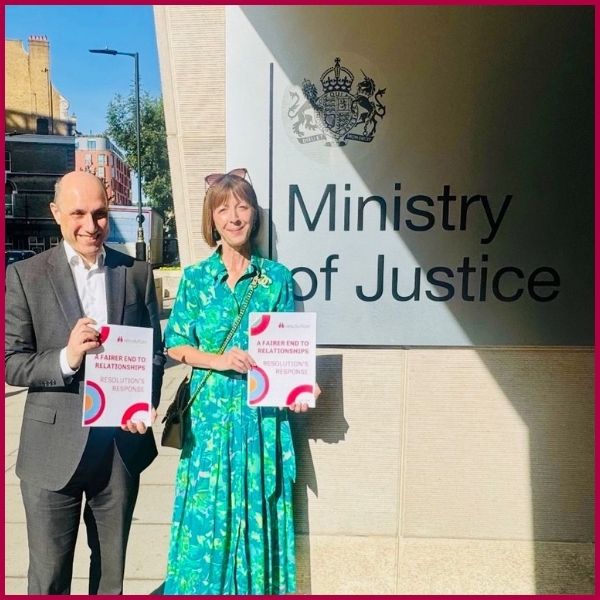
Resolution recently wrote to the new Parliamentary Under-Secretary of State at the Ministry of Justice, Jake Richards MP, urging him to press forward with cohabitation reform. We also set out a number of other key areas where we believe action is needed to improve the family justice system.
Resolution does not know how much time this Government will have to get legislation through Parliament, and our message to the new Ministerial team is therefore simple: bring forward a Bill at the earliest possible opportunity.
Our Chair, Melanie Bataillard-Samuel, says: “Too many people – often women – leave long-term relationships with no financial protection, despite having built a life together that is, in every meaningful sense, akin to marriage. The answer cannot simply be “get married”. Life, relationships and the choices people make are far more complicated than that.
“Some couples choose not to marry for financial or personal reasons. In other cases, one partner may actively resist marriage precisely because they know it would create financial obligations that their partner reasonably believes should already exist. The law should not leave people exposed simply because they did not marry.”
Jo Edwards, Chair of Resolution’s Family Law Reform Group, says: “Those working with separating couples overwhelmingly support this reform, as do domestic abuse campaigners, because it would address clear injustice and help those in a position of need at the end of a relationship (and any children). Failing to act would continue to leave people – particularly survivors of domestic abuse – without the protection they need to leave abusive relationships and rebuild their lives. Those who want to would have the option to opt out of any new framework.”
See letter below…
Dear Minister
Introduction to Resolution
I am writing to congratulate you on your re-appointment as Minister and to request that we arrange a meeting to discuss how we may support and inform your work.
I would also like to re-introduce Resolution. You may remember meeting with my colleagues Jo Edwards and Matt Bryant at Labour Party Conference in 2024, so we were particularly pleased to see you now have responsibility for family justice within the MoJ ministerial team after hearing your passion for justice first hand.
Resolution represents 6,500 family lawyers, mediators and other family justice professionals working with separating families across England and Wales. Our members work with thousands of separating families every day and are well-placed to share insights into how policy operates in practice. At the heart of all Resolution’s work is our aim to support families to resolve issues in a constructive manner that puts the needs of children first. We are proud of the strong and positive relationship we have had with Ministers and officials at the Ministry of Justice, including Baroness Levitt, and I hope we can continue to build on this with you and your team.
In particular, we have been working closely with officials on the recent consultation on reforming financial remedies on divorce and strengthening protections for cohabitants at the end of their relationship. Resolution has been calling for reform to protect cohabitants for decades, as the current system of no rights leaves too many vulnerable people, particularly women and children, without meaningful protection when a relationship ends through separation or a partner dies.
Many still mistakenly believe in the myth of “common law marriage,” only to discover too late that they face financial hardship, inequality and emotional distress because the law has failed to keep in step with the reality of how an increasing number of families (now some 3.5m in the UK and fast growing) are living their lives.
Reform in this area has therefore become increasingly urgent. We were delighted that the Labour Party manifesto pledged to strengthen the rights and protections available to women in cohabiting couples and the consultation that resulted. We sincerely hope the consultation process, now ended, will result in legislation at the earliest possible opportunity. Since the consultation began, our members have been contacted by people in desperate positions, with limited/no claims on separation despite years of being married in all but name.
For many, coercive controlling behaviour is often at the heart of it – one said, ‘Looking back I can see that the refusal to marry was all part of the pattern of control and that he never intended to marry me as he understood the financial consequences for him, whereas I just assumed that as a parent I had the same rights as married couples’. We hope that stories like these, whilst saddening, will serve as a reminder as to exactly why change in this area is so desperately needed.
Resolution will continue to advocate for reform for unmarried couples and we are keen to assist you and your colleagues with your efforts. Please do let us know if there is anything we can do to help. We are also planning media and parliamentary activity later in the year and would be delighted to include you in this; we are in regular contact and will continue to liaise with officials on the detail.
There are a number of other areas of family law reform which we say would help those navigating the family justice system, detailed in our Vision for Family Justice, which we published in 2023.
In particular, Resolution has long made the case for funding for initial family legal advice, to help families access tailored advice to find solutions at an earlier stage, navigate the court process (where that is needed) and to help reduce the demand on hard pressed family courts, freeing up valuable court time for those cases which most need judicial input. There is a clear correlation between the withdrawal of the provision of early legal advice for many family cases (through the Legal Aid, Sentencing and Punishment of Offenders Act 2012), and the rise in the number of litigants in person/court delays, as well as the fall in mediation numbers in the years following LASPO.
A few years ago, Resolution was working with officials to develop a pilot scheme for early legal advice. Whether through re-establishing the development of this scheme or other means of providing early legal advice for family matters, we hope that you will wish to continue to develop policy in this area as soon as possible, and would be happy to contribute our perspective and experience on this.
We also look forward to working with you and your team to ensure the rollout of Child Focused Courts (CFCs) is as effective as possible; we have members across the country who already have experience of the model and who we surveyed a few months ago, whose experiences are helpful in supporting practitioners in areas where CFCs are due to be introduced soon. We also shared the survey results with officials and are happy to continue to share our members’ experiences.
On behalf of our 6,500 members, I wish you the best of success in your new role and look forward to working with you to improve the family justice system in the interests of all.
Please could you ask your private office to contact our Head of Policy, Rachel Rogers, on [email protected], with a view to arranging a meeting.
Warm regards,
Melanie Bataillard-Samuel,
National Chair.