Changing the mindset: No-brainers and the Children’s Commissioner message to separating parents
 As a mediator I care greatly not just about doing the work, but being part of a community supporting cultural change in the way we think about and do divorce and separation in the UK.
Over recent years, family law has evolved significantly, and yet, socially, we are still catching up. When I talk about this change, I often use the analogy of the path to compulsory seatbelt wearing in the 1970s and early 80s. If you’re younger than me (I’m 55), it might seem like an odd reference – I’m going back a long way to a change that is a no-brainer. And that’s partly the point. It’s about the narrative of what must come together to embed social change.
From 1968, cars had to have seatbelts, but getting people to use them was difficult – they were “uncomfortable”, it was an “infringement of civil liberty”, “what difference would they make?”. The part of the story that lodged with me as a child was the public awareness campaign and prime time TV ads – “Clunk, Click on every trip” was a gamechanger on the road to making it no longer cool not to wear a seatbelt. A law to make seatbelt wearing compulsory came later to cement the change.
The transition to change begins when evidence and experience reveal a disconnect between what things could or should be like with how they are, and change starts to foment at grassroots level. With seatbelts, it was a safety issue and an understanding that a simple safety mechanism could save lives.
Still, it’s a slow journey from grassroots to systemic change with new rules or laws, and public buy-in is vital. The tipping point on behavioural change comes when the majority actively choose it because the benefits are understood. It becomes a no-brainer.
When a family is going through change the uncertainty causes stress. Everything feels under threat – home, financial security, clarity on what’s coming next, relationships – creating vulnerability and pressure that can undermine capacity to respond well and take the decisions that need to be taken. It is an emotionally challenging time for parents and children.
There is an ever-growing body of evidence on the impact and cost of high-conflict divorce on children and families, to the extent that it can be described as a social issue. (See, for example, the Family Solutions Group’s report on Inter-Parental Conflict and Family Separation). The President of the Family Division, Sir Andrew McFarlane, has acknowledged (on BBC Radio 4 in 2022) that adversarial language and processes in family court can make matters worse. Many disputes about children after separation are not truly legal disputes, and a legal response may be unhelpful for families trying to move forward.
Mediators and other family practitioners working with families have long been working to steer away from the hostile and adversarial to constructively collaborative, for best sustainable outcomes. This work has been bearing fruit, with policy and systemic changes implemented. Mediation has gone from the margins to the mainstream, with an expectation to mediate or use other processes of dispute resolution away from court now baked into the court system (see the Family Procedure Rules 2024). No-fault divorce was introduced in 2022, removing the necessity to point the finger of blame over breakdown.
I am proud to have been working with the Family Solutions Group which has been considering the way family law is practised. The Putting Children First report (March 2026) has taken the views and experience of hundreds of practitioners to consider the evolving role of the family law professional, and it makes strong recommendations (which will likely be discussed in the next issue of The Review).
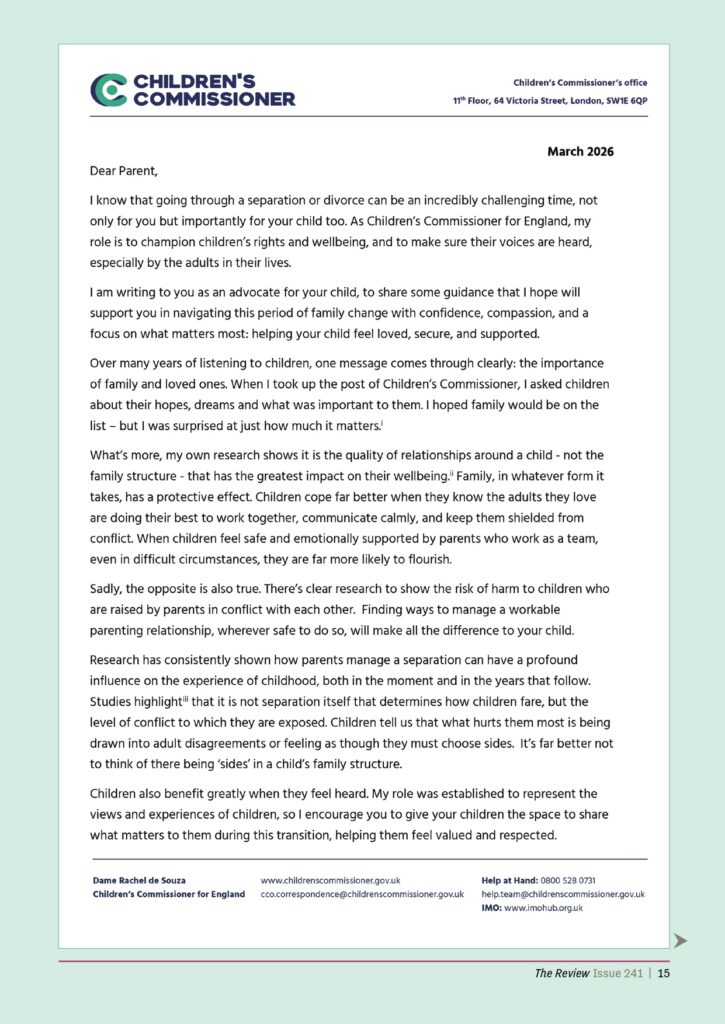
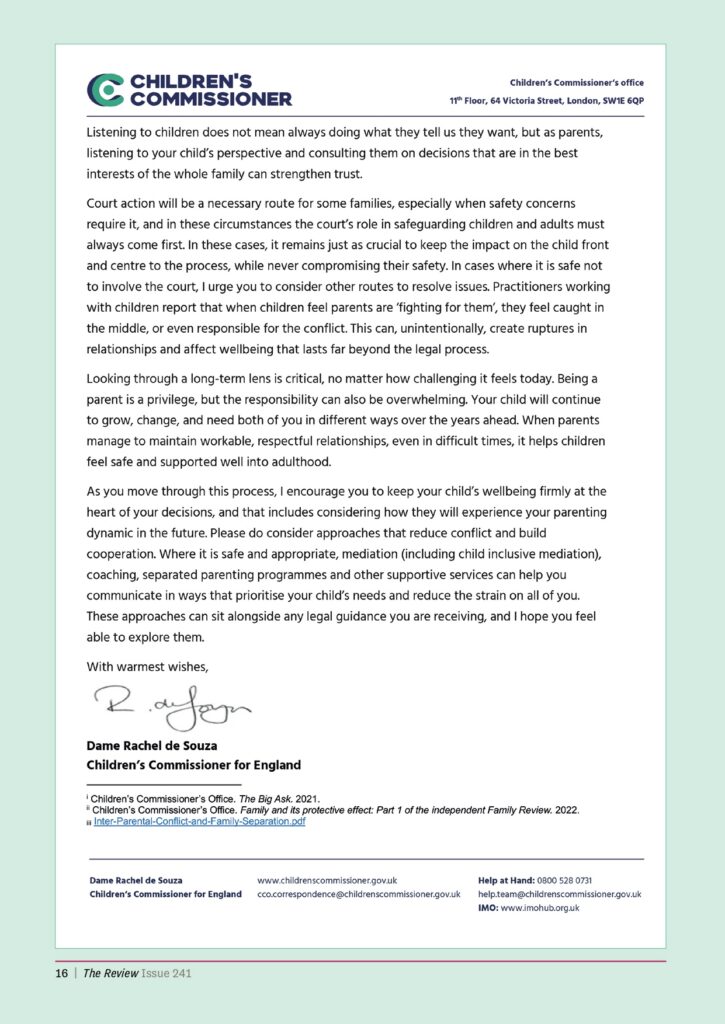
As part of this, I have been working with the Children’s Commissioner to deliver an open letter (printed here), written directly to divorcing and separating parents, to keep the focus on children, their wellbeing, and what “best interests” really look like. I hope it will become a no-brainer resource for solicitors, mediators and anyone else working with children and parents to share with clients, helping to embed a popular understanding of why it matters to divorce well, with child-focused decisions, so it becomes a no-brainer.