
Staying Sane in Family Law – what’s it all about?

Photo credit: Eddie Judd
If you’d told me back when I was in practice as a family solicitor that I’d one day write a book called Staying Sane in Family Law, I’d have laughed. I didn’t know then the twists and turns that my career would take. That I’d end up retraining as a therapist and setting up an agency devoted to making the legal world more psychologically informed and helping lawyers maintain their sanity. It’s been quite the ride.
Emotions are spilling everywhere in the family law world and while we’ve got a lot better in recent years in recognising that we need to pay attention to them, there’s still a way to go. It’s essential that we learn ways to deal with them that go beyond the strictly legalistic.
And I’m not just talking about clients’ emotions! We practitioners have feelings too (I know – shocking, isn’t it?). I find that those of us working in this field have a tendency to relegate our own feelings, to squish them down, usually because we think that’s what stoicism looks like. And yet, they find their way to the surface regardless. And the rise in reflective practice/therapeutic supervision in recent years has been a huge acknowledgment of the fact that we need to tend to our own emotions as well. Otherwise they come back to bite us on the proverbial behind. (See the previous article for Sophie and Kerry’s discussion of reflective practice and supervision.)
Yes Annmarie, but how can your book help me?
 Well, I’ve written the book I wish I’d read when I was a family solicitor and mediator. The central premise is that the way to improving your wellbeing as a family practitioner is to become psychologically informed. Why? Because doing so protects you against the worst difficulties of the job. Dealing with anger, vulnerability, suicidality, trauma, clients with mental health disorders and addiction, co-dependency, attachment disorder. These are all par for the course in the world of family law. And all these themes are explored in the book via case studies based on real-life experiences, accompanied by suggestions of psychologically informed ways of dealing with them.
I also cover the therapeutic school of Motivational Interviewing and how I believe the approaches and the spirit of MI is the key to working effectively with other people’s resistance.
Once we as practitioners start to develop an appreciation of what is going on for people psychologically and an understanding of therapeutic techniques for working with such dynamics, the effect can be revolutionary. To give an example, one of the most striking realisations for me when I was training to become a therapist was how clear it was that therapists don’t “rescue” vulnerable clients. They are there for them, they show compassion and empathy. But they do that alongside holding healthy boundaries and an ability to evoke from the client their own resources and ability to find solutions. They don’t sit on the phone with clients for hours on end. It struck me that so many of the delicate skills we were taught for dealing with such situations and many others, including anger and trauma were transferable to the work of the family law practitioner. And so that’s what I’ve done with this book – brought and adapted such skills to the world of family law.
Neurodiversity
This is a subject close to my heart and I’ve devoted a chunk of the book to it, including a case study involving a barrister and a client, both with their own diagnosis. I focus on ASC (autism spectrum condition) and ADHD as I believe many family law practitioners are getting to grips with such diagnoses in themselves, their clients and in relation to any children involved.
I also cover pathological demand avoidance in the book, a subject which many practitioners are not aware of. This is defined as ‘an extreme and anxious need to avoid everyday demands and expectations, even those the individual wants or needs to do’ and is associated with neurodivergence. I believe many of our clients display such traits and yet become labelled as ‘difficult’ without us delving further into what might really be going on for them. And that has a huge impact on our wellbeing as practitioners. This book will help you find alternative, more creative ways of working with such clients.
Why all of this matters for Resolution members
My hope is that Staying Sane in Family Law will be a companion for you. A book that you dip into again and again, drawing on the suggestions and the practical tips and trying out the ideas for working with clients and looking after yourself. I hope it helps to start conversations (even if that conversation just consists of ‘why does Annmarie make so many rubbish pop music references in her book?!’).
Staying Sane in Family Law is available here. Annmarie is delivering four training workshops around the country to coincide with the publication of the book: more details here.
Book review of Staying Sane in Family Law
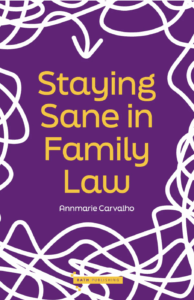 Do you remember why you chose a career in family law? My conversations with other family practitioners over the years tell me the answers are overwhelmingly similar: to help people; an innate curiosity about people and relationship dynamics; to use our skills, our intellect, for good; to make a difference. Reading Staying Sane in Family Law I was forced to reflect on how, for many of us, those genuine and good-natured intentions have somehow got lost along the way, forced to take a back seat to the everyday reality of demanding clients, “urgent” correspondence, quibbles over the contents of a single joint expert letter of instruction, monthly financial targets, measuring time in 6-minute units.
As Annmarie writes, it’s all too easy to lose heart in the hurly burly of it all. Her book is a timely and necessary touchstone to why we do what we do and how we can be doing it better, not just for our clients, but importantly, for ourselves. In it, she holds up a mirror to the problems facing the family law profession on an individual, emotional and psychological level. The result is confronting, but entirely accurate and affirming. Whether you are the lawyer who is consistently setting aside personal boundaries in aid of an emotionally needy client, the lawyer who loses sleep wondering if that mistake is going to get you struck off, or the lawyer who thinks all this emotional stuff is a waste of time and a distraction from the real law, you will find yourself in this book. Carvalho also brilliantly captures the myriad of clients we work with and shines the light on the repeating dynamics we see and the challenges they pose for both professionals and clients, practically and emotionally.
She tackles these topics with characteristic charm, vulnerability and humour. “I record time, therefore I am: The perils of toxic productivity” is just one of many great chapter names. Readers will also enjoy the peppering of pop culture references throughout the book; it is one of the clever ways Carvalho allows our guards to come down. Perhaps this feelings stuff isn’t so scary after all.
Ultimately, the message of the book is one of validation and empowerment. Sharing reflective and therapeutically informed tools, Carvalho offers real solutions to better support our clients. The section on Motivational Interviewing is particularly valuable; Carvalho shows us how simple adjustments in our language can transform our client’s experience, and our own. Other solutions are offered in the hardest-to-reach corners of our work: clients with suicidal ideation, clients who can’t make a decision, clients who are completely entrenched in their views and don’t seem to take in a word we say.
This is a book that asks the big questions and gives us credible and workable answers too. It is a call to action for a reimagined profession of family practitioners who are skilled at working holistically with clients and who, when we rest out heads on our pillows each night, can say “Today was a job well done”. If there were a compulsory syllabus for family law, Carvalho’s Staying Sane in Family Law has undoubtedly earned its place on that list.
Evie Smyth, Russell-Cooke LLP