
CILEX qualifications and practice rights: an overview
The Mazur case has raised a number of misconceptions about CILEX status, but ultimately reminds us that CILEX Lawyers are fully qualified legal professionals
Following the Mazur decision, and the first‑instance judgment in September 2025 and subsequent appeal, CILEX and its members have been the subject of increased scrutiny. Questions have been raised about the status and scope of CILEX qualifications, with some commentary suggesting that CILEX members are “unqualified lawyers”. In practice, this has contributed to some unhelpful misconceptions, including recruitment and workplace decisions.
CILEX Lawyers and Chartered Legal Executives are qualified legal professionals, although they qualify through a different route than solicitors. This article summarises the principal CILEX pathways (including historic and current frameworks), explains the terminology used for CILEX roles and titles, and outlines how practice rights and advocacy rights operate for CILEX Lawyers.
Background: the development of CILEX
CILEX has existed in various forms since the late 19th century. Established initially as the Solicitors’ Clerks Association (and later the Managing Clerks Association), the Institute of Legal Executives was founded in 1963 to provide a formal training route for solicitors’ clerks. In January 2012, the Institute was granted Chartered status and ILEX became CILEX.
Legacy qualification framework (pre‑2021)
During the 1980s, qualifications were structured as Part 1 and Part 2. Part 1 provided a broad grounding in legal knowledge and office practice, and was assessed by closed‑book written examinations, typically over two years. A pass led to Associate membership (ACILEX). Members then specialised through Part 2, completing linked law papers and a practice paper at degree level (for example, those in family practice might study Family Law, Tort, Contract and Family Practice). After passing Part 2, members were required to complete a further period of supervised practice (commonly two years), supported by employer confirmation of competence, before achieving Fellowship (FILEX or FCILEX) status. Study was generally undertaken part‑time alongside employment, and qualification often took six years or more.
Part 1 and Part 2 later evolved into the Level 3 and Level 6 framework to align with wider qualification standards. Mandatory modules in Client Care and Legal Research were introduced. During the COVID‑19 period, examinations moved online and assessment formats for some modules changed, including the introduction of multiple‑choice components.
Many members who qualified in the 1990s (and earlier) understood their professional standing to be broadly comparable to that of solicitor colleagues, subject to restrictions that applied at the time—for example, limitations on rights of audience and (historically) restrictions on partnership.
Regulatory context: the Legal Services Act 2007 and CILEX practice rights
The Legal Services Act 2007 reshaped the regulatory landscape to support a strong, diverse and effective legal profession. It introduced the concept of “authorised persons”, defined “reserved legal activities”, established approved regulators and facilitated alternative business structures.
In response, and following a successful petition to the Legal Services Board (LSB) in 2013 to allow Chartered Legal Executives to obtain litigation rights, CILEX Regulation developed additional pathways for members who sought advocacy rights. This was particularly significant in areas such as family work, where rights of audience in certain proceedings were historically denied to Legal Executives.
Initially, Fellows were required to obtain a certificate of eligibility for advocacy from ILEX following portfolio assessment before enrolling on the relevant course. Early family and criminal advocacy courses ran at Regent’s College in February 2008. At that stage, there were insufficient Fellows holding the certificate of eligibility for the civil course to run for some time.
The initial advocacy programme was delivered over six days. Fellows received the Law of Evidence materials (then Part 2, now typically aligned with Level 6) in advance and completed an evidence assessment during the course. The programme also required substantial written work (including skeleton arguments) and focused advocacy training, with observed roleplays using professional actors as witnesses and assessment by senior representatives of the Institute. In the first cohort, six Fellows were granted family advocate status, giving them rights of audience comparable to those exercised by solicitors in that context, subject to ongoing advocacy continuing professional development (CPD) requirements and a renewal process at the time. Unlike solicitors, CILEX advocate status initially operated through periodic renewal; following the first year, rights could become ongoing subject to meeting advocacy CPD requirements.
Later courses were developed in “reserved activity” practice areas, enabling eligible Fellows to obtain practice rights.
The CILEX Professional Qualification (CPQ) framework (introduced 2021)
- Foundation – examinations leading to the CILEX Diploma in Law and achievement of CILEX Paralegal status (generally Level 3 standard). Broadly takes 18 to 24 months to complete.
- Advanced – further study and assessment (including Ethics and Professional Responsibility), with optional recognition of professional experience, leading to the CILEX Advanced Diploma in Law and Practice and CILEX Advanced Paralegal status (generally Level 6 standard). Broadly takes 18 to24 months to complete.
- Professional – a final specialist (practice-specific) assessment, a Professional Skills project and completion of a Professional Experience Portfolio, typically during qualifying experience. In contentious specialisms, including family litigation, there is an optional CILEX Regulation‑approved Advocacy Skills course. Successful completion results in qualification as a CILEX Lawyer (generally Level 7 standard). A CILEX Lawyer is a qualified, authorised legal professional with practice rights in a specific area of law. (Broadly takes 12 to 18 months to complete).
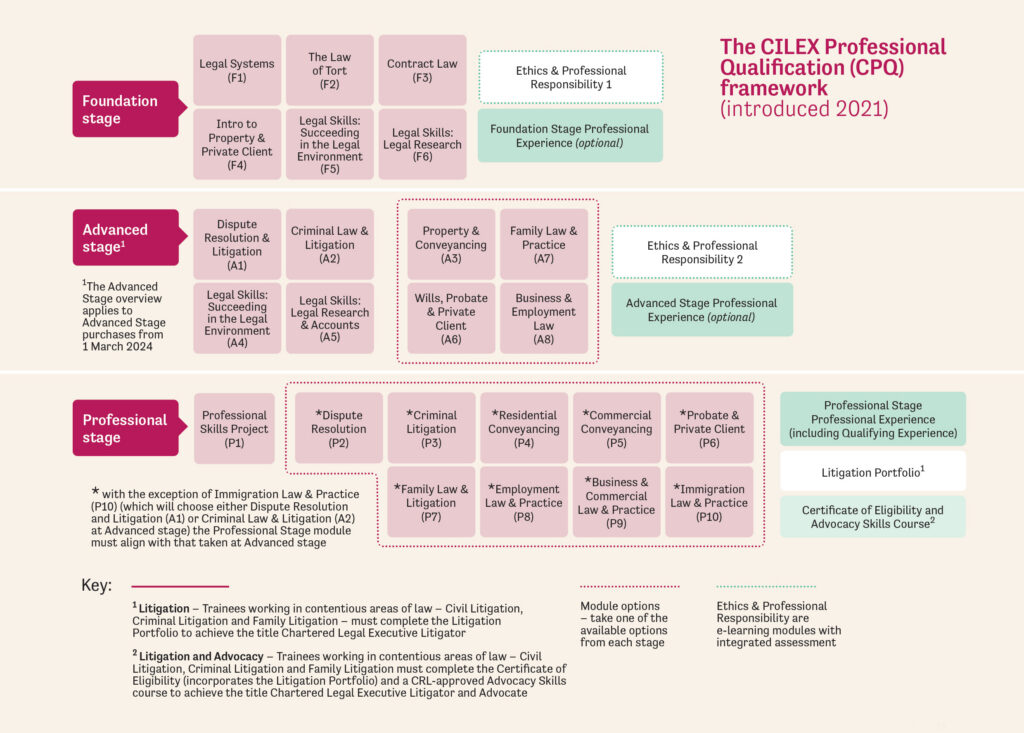
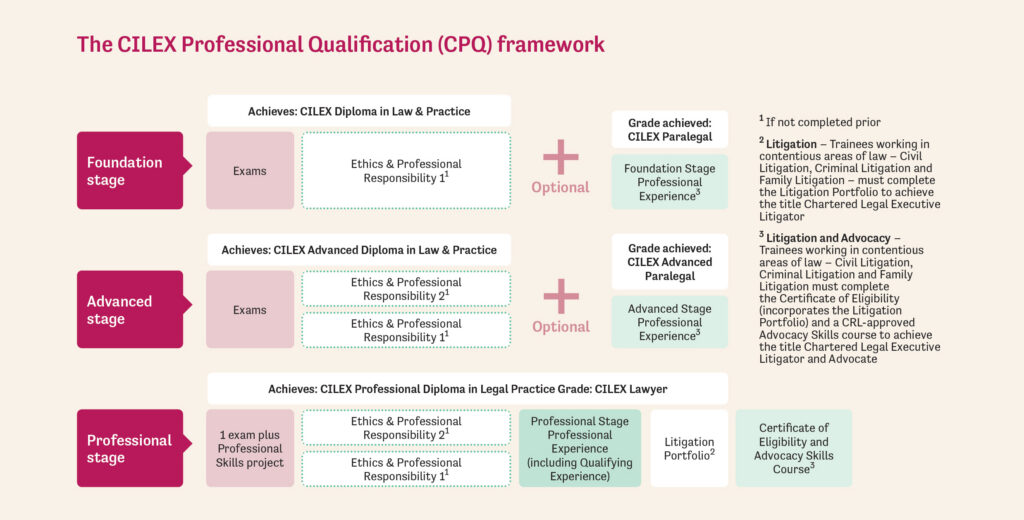
With the introduction of CPQ, students who had completed the CILEX Level 3 Diploma in Law and Practice could transition into the new pathway. On completion of CPQ, together with the required qualifying experience (commonly three years), individuals were able to qualify as a CILEX Lawyer.
Obtaining practice rights via the legacy route (for those who qualified or started before 2021)
For Fellows who qualified (or commenced study) before CPQ, practice rights are obtained through a separate application process (commonly referred to as the “legacy” route). Two routes are available:
Portfolio route: applicants compile a portfolio of evidence from their caseload to demonstrate competence across core practice outcomes. This typically includes evidence of client interviewing, advising and communication; costs and funding; professional conduct and ethics; working with other professionals; litigation management; dispute resolution and settlement; and legal writing and drafting.
There is no fixed timeframe for completion; reported averages for building a portfolio that evidences competence are approximately 9–12 months. Applicants must have worked in the legal sector for at least five years, including at least two years in their chosen specialist area.
Assessment route: under the assessment route, applicants demonstrate competence through a combination of assessments: (i) a 45‑question closed‑book multiple‑choice examination to test breadth of knowledge in the practice area; (ii) a mock client interview to assess client care and communication; and (iii) a written assessment completed immediately following the interview to test analysis and drafting. While the multiple‑choice element is intentionally broad, the interview and written assessments are designed to test depth in practical application.
The assessment programme is delivered online by the University of Law (at Level 7 standard) and typically takes around three months for self‑study or six months for guided study before candidates sit the assessments.
Following the Mazur judgment there was a significant increase in applications for practice rights, with an estimated 1,200 Chartered Legal Executives potentially needing to apply. Uptake of the portfolio and assessment routes has been broadly similar, and typical timeframes to completion are comparable. On successful completion of either route, legacy CILEX members obtain practice rights and may use the title Chartered Legal Executive Litigator (adding on the specific area of qualification, for example Family Litigation) and the title CILEX Lawyer. Those who have undertaken the advocacy course are designated the title Chartered Legal Executive Litigator & Advocate.
Advocacy rights and the decoupling of litigation and advocacy practice rights
Historically, legacy Fellows in contentious practice who sought practice rights were also typically required to complete the relevant advocacy skills course. Entry required a certificate of eligibility from CILEX Regulation, supported by evidence of advocacy experience (undertaken or observed). Following Mazur, and to support members in obtaining practice rights more efficiently, CILEX Regulation obtained approval from the LSB to decouple litigation rights from advocacy rights. This reflected the practical reality that some professionals in contentious practice do not routinely undertake advocacy.
Paralegals and progression within the CILEX framework
In 2023 CILEX acquired the Institute of Paralegals and the Professional Paralegals Register, bringing additional paralegals under the CILEX umbrella. Paralegals who previously qualified through the Institute of Paralegals (including Chartered Paralegals, some of whom assisted in trialling the CPQ Paralegal assessment route) are unable to automatically transition to CPQ in the same way as some trainee/student legal executive members on the earlier CILEX framework. This has come as a blow to those affected. To qualify as a CILEX Lawyer via CPQ, paralegal candidates must complete the CPQ stages outlined above, even if this means replicating past studies. Completion of the Foundation stage confers CILEX Paralegal status, with progression available to CILEX Advanced Paralegal status and, for those who choose to proceed further, qualification as a CILEX Lawyer.
Conclusion
CILEX Lawyers qualify in a specialist field through a combination of structured study and substantial practical legal experience. Where practice rights are granted (and, under CPQ, integrated within the qualification), CILEX Lawyers are authorised legal professionals in their practice area and may assume responsibility for their own caseloads and clients and, where appropriate, supervise others. CILEX members can and do hold senior roles within practice, including partnership, establishing their own practices and appointable to judicial office (subject to the applicable eligibility criteria).
CILEX Lawyers are fully qualified legal professionals: their route is equivalent to but different from that of solicitors. They follow a recognised, regulated and rigorous pathway to authorisation.
For further information about CILEX pathways and titles, please contact the authors of this article or reach out to Jon Woodcock or Lydia Jones at CILEX.
This article was written by Juliet Harvey (Birketts LLP) with contributions from Felicity Lister (Family Law Consultants), Kristy Underwood (Stevens Drake), Dawn Gore (Trethowans), Charlotte O’Brien (Birketts LLP) and Francesca Dooley (Birketts LLP).