
“Putting Children First”: key changes we feel the profession must embrace
Edward Cooke and Charlotte Bradley, co-authors of the Family Solutions Group’s new report, share key findings and what it means for family law professionals
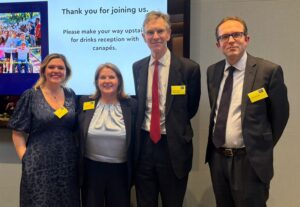
Carlie Norris, Charlotte Bradley, Sir Stephen Cobb and Edward Cooke at the launch of the FSG report.
“Every conversation, every decision and every professional interaction with a parent has a ripple effect on the child at the centre.” These are the words of 17-year-old Amelia, who wrote one of the two forewords to the new Family Solutions Group (FSG) report, “Putting Children First”. (The other foreword is from our new Family Division President, Lord Justice Cobb, who attended our 12 March 2026 launch.)
The FSG report argues that family law practice is at a pivotal moment. The legal landscape has seen welcome change in recent years, such as the introduction of no-fault divorce in 2022 and the April 2024 amendments to the Family Procedure Rules; however, legislation cannot, on its own, bring about a change to a more solution-focused, less adversarial system.
As our report highlights, in order to ensure our professional interactions with families are as constructive as they can be, we need to recognise our evolving role as family law professionals.
Survey findings
Our report sought to examine the role of legal professionals (including solicitors, barristers, legal executives, mediators, paralegals, judges and magistrates) in the evolving family law landscape – and how this landscape should shape our role going forward.
We received 546 responses to a survey issued in the first quarter of 2025, from a range of individuals working with families. They included not only legal professionals but also individuals from the therapeutic community and 79 parents too. We felt it important to consider the view not only of family legal professionals but also those working more broadly with separated families, and parents themselves.
In addition, we interviewed nearly 50 key figures working across the family separation arena. Their insights are woven through our report and were immensely helpful in shaping our thinking.
The survey focused on four areas:
- The role and responsibilities of the family law professional: 92% of respondents agreed with the proposition that, in addition to their duty to their client, legal professionals should have a wider duty to the children of the family.
- The voice of the child: 84% were in favour of including the voice of the child as standard practice in all out-of-court resolution processes addressing child arrangements.
- Training: 91% were in favour of mandatory non-legal skills training for legal professionals.
- Reflective supervision/practice: 79% were in favour of the suggestion that all family legal professionals should have such supervision.
Implications for family legal professionals
There is insufficient space here to summarise every finding of a report running to over 90 pages and appendices, but one of our central recommendations is that there should be a responsibility on all family legal professionals to consider the impact of family separation on a child’s experience and wellbeing, and to support families in ways that reduce conflict.
We also call for the establishment of a Commissioner for Separated Families which, in the new President’s words, would “bring leadership, oversight and co-ordination across a patchwork landscape to address both child and adult issues… and both short-term support and long-term strategy”.
Other recommendations are:
Responsibility to children
All family law professionals should advise clients of the impact of poorly handled separations and the importance of the child’s voice being heard. Family professionals should also send separated parents a letter (annexed to the report) signed by the Children’s Commissioner, which aims to keep the focus on children, their wellbeing, and their best interests (see Joanna Gosling’s article in the last issue for the full letter). Practitioners should also provide clients with details of child-focused professionals and resources, including separated parenting programmes.
Child welfare
Within the remit of the newly established Commissioner for Separated Families, there should be a review of the child welfare principle. Child welfare is the golden thread running through the report. We point out that this concept is not consistently applied across family law, and has not been comprehensively reconsidered for over 30 years. In this regard, we argue it is vital for the forthcoming government consultation on financial remedy reform and the law surrounding cohabitees to expressly consider the impact on children and their welfare in all such cases.
Voice of the child
We recommend that hearing the voice of the child should be standard in both court and out-of-court processes. With this in mind, we recommend that any lawyer who has a retainer with a parent of a child aged 18 or under should engage in ongoing professional development to strengthen their understanding of the importance of the child’s voice.
The FSG has developed a model of child-inclusive practice, through which we propose children’s voices can be heard more often in cases involving solicitors. Full details are available on the “Children’s Voices in Family Separation” page on the FSG website, and the protocol is appended to our report.
Training
We call for the introduction of a Family Solutions kitemark (under the oversight of the Commissioner). We recommend all legal professionals working with separated families undertake training on how to reduce conflict and support separating parents (including essential non-legal skills such as psychological issues, domestic abuse and supporting clients in NCDR), so as to earn this kitemark.
Ultimately, we believe such training is essential for all family legal professionals (as our survey response overwhelmingly finds), but will take time to roll out. The development of a kitemark, to come under the oversight of the Commissioner, would also be rolled out for all professionals over time, including not only those working in the regulated sector but also, crucially (as our report identifies), those in the non-regulated sector, which has grown substantially since the 2014 cuts to legal aid.
Some respondents were concerned about the burden on firms to ensure all in their team have the appropriate training, when such requirements may not apply to the non-regulated space – our recommendations seek to ensure a level playing field, with all professionals over time being required to adhere to standards and training, overseen by the newly established Commissioner.
Supervision
Finally, our survey found strong support for reflective supervision and emphasised that psychological support for professionals working with families not only benefits our clients, but also their children. We suggest that a regime where all professionals receive such supervision would be hugely beneficial.
As Amelia identified at the outset of our report, the ripples from our professional actions, through the tone of our communications or correspondence, or the way in which we approach the resolution of our client’s case, can be huge. Moreover, the very nature of our work means we are exposed to vicarious trauma on a daily basis. We need to ensure we are equipped with the right support and supervision to manage not only our client’s and their children’s complex needs, but also to ensure we look after ourselves in what can be a stressful job.
Conclusion
In his address welcoming the report, Sir Andrew McFarlane stressed the need for a change of culture in society, the government and the legal professional, to look for resolution options away from court. Moving away from our traditional adversarial model “may well have some resistance from lawyers”, he said, but “We need to be serving the clients and serving the children in the most effective way.”
Crucially, he added: “This won’t mean less work for lawyers”, but, instead, different and more satisfying work.
We hope our report lays down a blueprint for the continued evolution in all of our practices. As our conclusion says: “If we reshape our approach to truly put children first, we can change the experience of separation for the next generation of children.”